
Generative AI Tools for Retail Brands

Veejay Ssudhan
August 13, 2025Generative AI has moved from buzzword to business tool. For retail brands, it can improve product discovery, cut content costs, and personalize experiences at scale—all while helping teams work faster. This guide covers the main categories of Gen AI tools available today, practical use cases, vendor examples, and how to get started safely.
1. Product Discovery and Search
What it is:
- Tools that use large language models (LLMs) and vector search to understand shopper intent in natural language, not just keywords. They match queries to product attributes and unstructured content (images, reviews).
Use cases:
- Natural language search: “Black waterproof hiking boots under $150 with good ankle support.”
- Semantic browse and filters: Dynamic facets that adjust based on shopper intent.
- Product finders and quizzes powered by LLMs.
- Auto-complete and dynamic synonym expansion.
- Visual search: Upload a photo to find similar items.
Vendors and approaches:
- E-commerce platforms: Shopify Search & Discovery with AI boosts, Shopify Sidekick for merchant support; Salesforce Commerce Cloud Einstein; Adobe Commerce (Magento) with Adobe Sensei.
- Retail search specialists: Algolia NeuralSearch, Coveo Relevance Cloud, Bloomreach Discovery, Constructor.io, Klevu, Elastic with vector search.
- Visual search: Google Cloud Retail Search (part of Vertex AI), Syte, ViSenze, Clarifai, Meta AI for Images.
What to watch:
- Cold-start product coverage, handling long-tail queries, multi-language support.
- Latency and cost of vector retrieval and LLM re-ranking.
- Guardrails: bias in results, hallucinated attributes.
2. Merchandising, Pricing, and Forecasting Co-pilots
What it is:
- AI assistants that help planners and merchandisers analyze demand, recommend assortments, adjust prices, and optimize promotions.
Use cases:
- Demand forecasting at SKU/store/region level from historical sales, weather, events, and marketing data.
- Markdown optimization and dynamic pricing recommendations.
- Assortment planning: cluster stores and auto-build localized assortments.
- Promo simulation: predict lift, cannibalization, and margin impact.
- Vendor negotiations: summarize PO histories and trade terms.
Vendors and approaches:
- Enterprise suites: o9 Solutions, Blue Yonder, SAP IBP, Oracle Retail with embedded ML/Gen AI assistants.
- Data clouds with Gen AI: Google Cloud Vertex AI, AWS Bedrock + SageMaker, Microsoft Fabric + Azure OpenAI for custom copilots.
- Specialized: Afresh (fresh grocery), aifora (pricing), Revionics (pricing), Nextail (allocation), Invent Analytics (inventory).
What to watch:
- Data quality and availability (inventory accuracy, calendar/promotions).
- Explainability for planners and finance sign-off.
- Governance on autonomous actions (set clear approval thresholds).
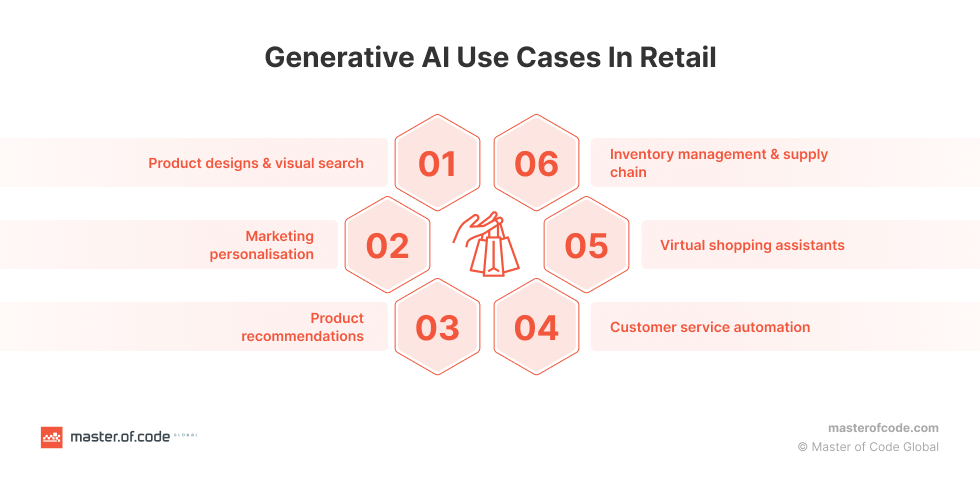
3. Customer Service and Post‑Purchase Assistants
What it is:
- Gen AI chat, email, and voice agents trained on your policies and order data to resolve issues and reduce contact volume.
Use cases:
- Order status, returns/exchanges, warranty and care, store hours.
- Policy Q&A with tone control and multilingual support.
- Agent assist: live summaries, suggested replies, after‑call notes.
- Proactive messages: delays, back-in-stock, delivery changes.
Vendors and approaches:
- CRM platforms: Zendesk AI, Salesforce Service GPT, Freshworks Freddy, Kustomer AI.
- Conversational AI: Ada, Ultimate, Forethought, LivePerson, Intercom Fin, Lang.ai.
- Voice IVR: Amazon Connect with LLMs, Google Dialogflow CX + Vertex AI.
What to watch:
- Secure integrations: OMS, WMS, carrier tracking, CRM.
- Deflection vs. CSAT: escalate gracefully to humans.
- Compliance: logging, PII redaction, opt-out for training.
4. Marketing and Content Generation
What it is:
- Tools that generate copy, images, and videos for ads, emails, PDPs, and social. They can also personalize content per audience or channel.
Use cases:
- PDP copy: features, benefits, SEO meta, structured specs.
- Ad variants: titles, CTAs, headlines for A/B testing.
- Email subject lines and content tuned by segment.
- Social content calendars, captions, and UGC moderation.
- Product imagery: background removal, scene generation, model swaps.
Vendors and approaches:
- Multimodal suites: Adobe Experience Cloud + Firefly, Canva, Figma with plugins, Descript (video), Runway (video).
- Copywriting: Jasper, Copy.ai, Writer, Grammarly Business.
- Image generation: Midjourney, OpenAI DALL·E, Stability AI and Remaker AI
- Retail-specific: Shopify Magic for product descriptions, Klaviyo AI for emails, Attentive AI for SMS copy, Bazaarvoice for UGC moderation.
What to watch:
- Brand voice controls, tone and compliance checklists.
- Rights and licensing for generated media; ensure commercial usage clarity.
- Measurement: tie content variants to sales impact, not just clicks.
5. Personalization and Recommendations
What it is:
- Systems that use embeddings and generative re-ranking to show the right products, content, and offers to each shopper.
Use cases:
- Home, category, and PDP recommendations infused with LLM summaries (“Pairs well with…”).
- Bundles and outfits auto-generated from catalog embeddings.
- Onsite copy that adapts to audience (new vs. returning; value vs. premium).
- In-session personalization using activity signals in real time.
Vendors and approaches:
- Established platforms: Dynamic Yield, Algonomy, Bloomreach Content + Discovery, Adobe Target, Insider, Emarsys, Monetate.
- Data cloud + custom: use your CDP (Segment, mParticle, ActionIQ) + Vertex AI/Azure OpenAI to build bespoke policies.
- Fashion-focused: Stylitics (outfitting), Vue.ai (catalog tagging + recommendations).
What to watch:
- Cold start for new items and anonymous users.
- Diversity and fairness (avoid narrow loops).
- Merch rules: inventory thresholds, margin constraints, brand priorities.
6. Catalog Enrichment and Operations
What it is:
- Tools that auto-tag, clean, and enrich product data from images and vendor feeds, and speed up back-office tasks.
Use cases:
- Attribute extraction from images/text: materials, patterns, necklines, compliance flags.
- Title normalization and duplicate detection.
- Size chart extraction and fit notes.
- Translation/localization at scale with brand glossary.
- SOP generation, store comms, and analytics summaries.
Vendors and approaches:
- Data platforms: Akeneo PIM with AI, Salsify, Syndigo.
- Vision + LLM: Google Vertex AI Vision, AWS Rekognition + Bedrock, Clarifai.
- Workflow copilots: Microsoft 365 Copilot, Google Duet AI, Notion AI, Atlassian Intelligence.
What to watch:
- Precision/recall on critical attributes (materials, safety).
- Human-in-the-loop workflows and audit trails.
- Integration with PIM/ERP and retail taxonomy consistency.
7. In‑Store Applications
What it is:
- Gen AI combined with vision and edge devices to support associates and improve store execution.
Use cases:
- Associate copilot: quick answers on product specs, inventory, planograms, returns policy.
- Computer vision: shelf gap detection, price label verification, planogram compliance.
- Clienteling: AI summaries of customer profiles and tailored recommendations.
- Voice notes and task summaries for managers.
Vendors and approaches:
- Devices and platforms: Apple Business Chat + custom LLM apps, Microsoft Teams with Copilot, Zebra Technologies, Scandit.
- Vision partners: Trax, Focal Systems, Pensa Systems.
- Clienteling: Salesforce Clienteling, Tulip, NewStore with AI assist.
What to watch:
- Offline/edge reliability, privacy, and BYOD policies.
- Sync with POS, inventory, and clienteling CRM.
- Training and change management for associates.
How to Choose and Implement Safely
- Start with a clear problem and KPI:
- Reduce contact volume by 30%
- Lift search conversion by 10%
- Cut PDP content costs by 50%
- Improve forecast accuracy by 3–5 points
- Pick the right data foundation:
- Clean product catalog, inventory, order data, and web/app events.
- Centralize in a warehouse (Snowflake, BigQuery, Databricks).
- Tag data sensitivity and set access controls.
- Evaluate vendors with a pilot:
- Use your real catalog and traffic; measure hit rate, conversion, latency.
- Run A/B tests where possible.
- Check integration effort: APIs, webhooks, SDKs, connectors.
- Set guardrails:
- Policy grounding: tools should cite sources and follow your policy text.
- Safety: profanity, PII redaction, and hallucination checks.
- Human-in-the-loop for high-risk actions (pricing, customer refunds).
- Plan for governance:
- Data retention, model training opt-outs, and audit logs.
- Bias and fairness reviews for recommendations and pricing.
- Model update cadence and rollback plans.
- Train your teams:
- Create prompt libraries and style guides.
- Define approval workflows for content and customer-facing responses.
- Share dashboards to track ROI and quality issues.
Quick Start Stack by Goal
- Better search and PDPs:
- Algolia or Bloomreach for semantic search
- Shopify Magic or Jasper for PDP copy
- Cloud Vision for auto-tagging images
- A/B test with Google Optimize alternative or native platform testing
- Reduce support tickets:
- Zendesk AI or Intercom Fin for deflection
- Order/tracking integration via middleware (MuleSoft, Segment)
- Guardrails and human escalation paths
- Personalized marketing at scale:
- CDP (Klaviyo, Salesforce, Braze) with AI subject lines and send time
- Dynamic Yield or Insider onsite personalization
- Creative generation via Adobe Firefly/Canva with brand templates
Measuring Impact
- Core metrics:
- Search: zero-result rate, add-to-cart from search, revenue per visit.
- Content: time-to-publish, content errors, organic traffic to PDPs.
- Service: first contact resolution, CSAT, deflection rate, refund accuracy.
- Personalization: CTR, conversion, AOV, margin contribution.
- Merch/pricing: forecast accuracy (MAPE), sell-through, markdown cost.
- Qualitative checks:
- Brand tone adherence and compliance issues.
- Edge case handling: complex returns, multi-item orders, BOPIS flows.
- Associate feedback in stores.
Cost and ROI Considerations
- Pricing models vary: per seat, per API call, per 1,000 tokens, GMV-based, or bundle in suites.
- Hidden costs: data prep, integration, prompt engineering, evaluation, and human review.
- ROI often shows within 3–6 months if tied to a measurable funnel component (search, recommendations, support deflection).
Final Thoughts
You don’t need to implement everything at once. Pick one or two areas with clear pain and measurable upside—search, PDP content, or support are common wins. Use a structured pilot, keep humans in the loop where needed, and build a small internal “AI council” across marketing, merchandising, IT, and legal to set standards.
With the right guardrails and data, gen AI can help retail brands create richer experiences, operate leaner, and grow faster.
All Tags
Loading...
Loading...