
How to Convince a Customer to Buy CVD Diamonds

Jennifer Olson
August 18, 2025Convincing a customer to choose CVD (Chemical Vapor Deposition) diamonds isn’t about pressure; it’s about clarity, trust, and value. Many shoppers have heard of lab-grown diamonds but still carry doubts: Are they real? Do they last? Do they hold value? Your job is to guide them through a confident, informed decision. Here’s a structured approach you can use in-store or online to convert curiosity into a purchase—while building long-term trust.
- Start with discovery: understand what matters to them Before you pitch, ask targeted questions. This frames your conversation and shows you’re focused on their priorities.
- What’s most important to you: size, sparkle, budget, or origin?
- Are you open to lab-grown, or are you still deciding?
- Do you prefer a particular shape or setting?
- Is sustainability important in your purchase?
This early discovery helps you tailor the benefits of CVD diamonds to match their values.
- Clarify what CVD diamonds are (and what they’re not) Many customers confuse CVD diamonds with simulants like cubic zirconia or moissanite. Clear that up simply:
- CVD diamond is the real diamond. They are made of pure carbon, with the same crystal structure as mined diamonds.
- They are grown in controlled lab environments that mimic the natural diamond-forming process.
- They’re graded by the same standards as mined diamonds (cut, color, clarity, carat) and certified by independent labs (e.g., IGI, GIA for lab-grown).
Keep it short, visual, and factual. If you have a loupe, show them. When you’re online, use side-by-side photos, light performance videos, or certificates.
- Lead with benefits that match their priorities Customers buy benefits, not features. Tie CVD advantages directly to their goals.
If they value size and sparkle:
- Bigger look for the budget: With the same budget, many shoppers can afford a larger or higher-quality diamond when choosing CVD.
- Better cut and clarity options: Because of lower price points, buyers often upgrade to excellent cut or higher color/clarity without breaking the bank.
Do they care about ethics and sustainability?:
- Traceable origin: CVD diamonds have transparent sourcing—grown, not mined.
- Lower environmental impact: While labs use energy, CVD avoids large-scale mining, heavy land disruption, and complex supply chains.
- CVD diamonds has become one of the often spoken examples for technology impacting the jewelry industry.
If they’re worried about quality and longevity:
- Same durability: CVD diamonds rank 10 on the Mohs scale, just like mined diamonds. They’re equally hard and suitable for daily wear.
- Certified and insurable: They’re graded by recognized labs and can be insured like any other diamond.
- Use simple comparisons, not complex science Avoid overwhelming customers with technical terms. Offer concise comparisons:
- CVD vs. mined: Same chemistry, same brilliance. The difference is origin and typically price.
- CVD vs. moissanite or CZ: Moissanite is silicon carbide; CZ is zirconium dioxide—both are simulants with different optical properties. Only CVD is a diamond.
If helpful, explain why CVD often has fewer metallic inclusions than some HPHT-grown diamonds, and how high-quality CVD processes produce excellent clarity and color. Keep it practical and visual.
- Address the most common objections with empathy You’ll hear these often. Have calm, clear answers ready.
- “Are they real diamonds?” Yes—CVD diamonds are real diamonds with the same physical, chemical, and optical properties as mined diamonds. They’re graded and certified by the same labs.
- “Will it last?” Yes. A CVD diamond is as durable as a mined diamond. It won’t cloud or change over time. It can be passed down, reset, and polished just like any diamond.
- “What about resale value?” Any jewelry resale varies by market. Historically, most retail diamond purchases—mined or lab-grown—resell for less than the original retail price. People buy diamonds for meaning, beauty, and daily wear, not as a short-term investment. With CVD, customers get better size and quality for their budget today.
- “Will people know it’s lab-grown?” Not by looking. Only specialized equipment can distinguish lab-grown from mined. The difference is disclosed on the certificate and laser inscription for transparency.
- “Is it ethical?” CVD diamonds offer clear traceability and reduce the environmental and social complexities associated with mining.
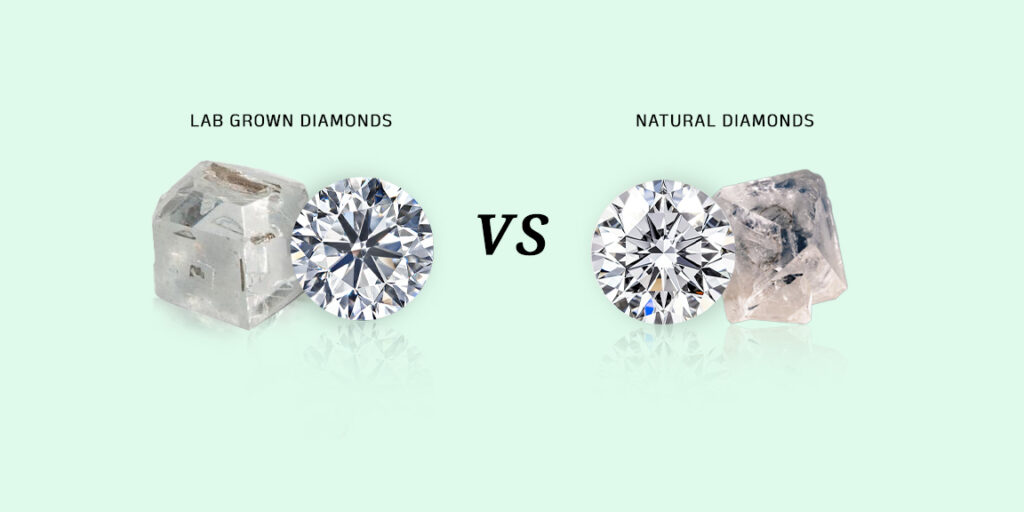
6. Provide proof: certification, inspection, and visuals Trust grows with evidence.
- Show certifications: Present GIA or IGI lab reports for the exact stone. Point out color, clarity, cut grade, and any fluorescence.
- Use a loupe: Demonstrate the cut quality, symmetry, and inclusions (or lack thereof).
- Light performance: If you can, show ASET/IdealScope images or simple videos under different lighting to demonstrate brilliance and fire.
- Laser inscription: Show the certificate number inscribed on the girdle for traceability.
- Anchor value with transparent pricing Don’t just say “it’s more affordable.” Quantify it.
- Example framing: “For this budget, a mined diamond might be around 1.0 carat, H color, SI1 clarity. With CVD, you can step up to 1.5 carats, G color, VS2 clarity with an excellent cut.”
- Offer side-by-side comparisons within their budget so they can see the trade-offs themselves.
- Sell the setting and the story, not just the stone Most buyers imagine the finished piece. Help them visualize it.
- Try-on experience: Use sample settings, 3D renders, or virtual try-on tools.
- Style guidance: Discuss metal color (yellow, white, rose), prong styles, and band width. Explain how different cuts look on the hand.
- Personalization: Offer engraving, hidden halos, custom baskets, or matching bands. The more personal, the more compelling.
- Use social proof and policies to reduce risk
- Reviews and testimonials: Share photos and quotes from happy customers who chose CVD diamonds.
- Policies: Highlight return periods, resizing, maintenance, and warranty. Risk reversal boosts confidence.
- Trade-up options: If you offer lifetime upgrades (even within lab-grown), explain how it works.
- Keep your language honest and balanced Avoid overpromises or putting down mined diamonds. Many customers just want a clear, respectful comparison.
Good phrasing:
- “Both options are beautiful; CVD gives you more size or higher quality for the same budget.”
- “If ethical sourcing and budget efficiency are important, CVD is a strong fit.”
- “Let’s look at both and see which one you love more in person.”
Make the process simple Friction loses sales. Streamline steps:
- Curate 3–5 stone options that match their criteria and budget.
- Provide a clean summary: price, specs, certification, key visuals.
- Offer a short, confident recommendation based on their stated priorities.
- Give a clear timeline for production, setting, and delivery.
Sample script you can adapt Customer:
“I’m not sure about lab-grown. Are they real?” You: “Yes—CVD diamonds are real diamonds with the same carbon structure as mined. The main difference is origin and price. With your budget, you could get a 1.4 carat, G color, VS2 with an excellent cut—versus about a 1.0 carat mined stone in similar quality. Would you like to see both side by side with their certificates?”
Customer: “Do they hold value?” You: “Resale depends on market conditions, and most jewelry sells for less than retail—whether mined or lab-grown. People typically buy for beauty and meaning. If getting the best size and sparkle today matters, CVD gives you more value now. We also provide a trade-up option if you want to upgrade later.”. Are these called also manufactured diamonds?.
Customer: “Is it ethical?” You: “CVD diamonds offer clear traceability and avoid large-scale mining. If sustainability and origin transparency are important to you, CVD aligns well.”
- Quick checklist for your team
- Ask discovery questions before presenting options.
- Present 3–5 stones with clear specs and certificates.
- Use simple language and visual tools (loupe, videos, images).
- Tie benefits to their stated priorities.
- Preempt common objections with short, factual answers.
- Highlight policies: returns, warranty, resizing, maintenance.
- Close with a recommendation and next steps.
- Close confidently and helpfully When the customer has seen enough, summarize and guide next steps:
- “Based on what you told me—bigger size, excellent sparkle, and ethically sourced—this 1.40 ct G/VS2 CVD with an excellent cut is the best match. In this platinum solitaire, it will be timeless and balanced. We can have it set and ready by next Friday. Would you like to proceed with this stone, or compare it against one slightly larger at H color?”
This gives them a clear path without pressure.
- Bonus: train your visuals and content If you’re selling online or through social media:
- Post macro videos of CVD stones under different lighting.
- Share side-by-side comparisons (same specs, different origins).
- Publish short explainers on certification and grading.
- Feature real customer stories and proposal photos.
Final thought
Customers choose CVD diamond when they feel informed, respected, and confident. Keep the message simple: real diamond, excellent value, traceable origin, and certified quality. Match the benefits to what they care about most, show proof, and make the process easy. Do that consistently, and you won’t just convince customers—you’ll create enthusiastic advocates.
All Tags
Loading...
Loading...